
PART 6 • THE ART OF THE DEAL
The art of the deal: Finding, assessing, and buying commercial property
CHAPTER 01
Introduction
The first five parts of this series covered the theory: whether commercial property belongs in a portfolio, what to buy, where it goes wrong, how to fund it, and how to make it work harder. Part 6 turns from theory to acquisition. How does a sophisticated commercial investor actually find and execute a deal?
The answer is a process, and this report sets out its seven steps: define the brief, find opportunities, assess the property, complete due diligence, determine value, negotiate and, above all, know when to walk away. The steps are not strictly sequential. The first three run in order, but due diligence, valuation, and negotiation then run in parallel, and each can change the answer to the others.
This report draws on the final conversation between Phil Tarrant and Right Property Group founder Victor Kumar. Given the explosion in the number of property professionals expounding the benefits of commercial real estate, the tone of the series has been deliberately cautious. Victor’s view is that once the challenges have been addressed, an investor is far safer. The series is not a case against commercial property. It is a set of guardrails on what is often a very narrow path, because not all commercial property constitutes a good investment.
But when you find the right deal, your portfolio will be transported to the next level.
“Once you address all the negatives and things that can go wrong, you’ll be perfectly safe.”
– VICTOR KUMAR, RIGHT PROPERTY GROUP
CHAPTER 02
A small pond: Why patience is a strategy
Good deals are scarce. Phil relayed a story from an accountant who works across the property investment space and sees about two good commercial deals for every eight not-so-good ones. Victor’s own screening numbers show why. A residential search might produce a shortlist of about 200 properties, of which 30 or 40 pass his filter. In commercial, finding 200 worth examining would be difficult, and only two would meet the required fundamentals for investing.
It means that one of the most important variables to success in commercial property investing is a personal attribute: patience to find the right deal. Your perfect commercial asset may not even be on the market yet.
FROM THE SOURCE
From 450k listings to 1 or 2
Victor estimates that the major property portals typically carry around 450,000 residential listings, against 120,000 to 125,000 commercial listings. A significant share of the commercial listings are not investable: development sites and vacant land with approvals are routinely marketed as commercial. Excluding these leaves about 50,000 listings, of which perhaps one or two would meet a given investor’s brief. It is possible that neither would withstand the screening process described below.
The lesson: Commercial search is a different task from residential search. Each property is different, so the filters on the portals are limited. For the same reason, a list of the top suburbs to buy commercial property cannot be produced. Every investor’s brief and situation is different, and there is no search that returns, for example, every cold storage warehouse in South Brisbane of a given size.
This scarcity makes patience a strategy. In commercial, deals, due diligence, and finance all take longer. The danger is search fatigue: investors who have lost out on several good properties, or cannot find one, panic and buy the next thing that comes along.
“Patience is a strategy when it comes to buying effectively.”
– PHIL TARRANT, SMART PROPERTY INVESTMENT
CHAPTER 03
Step 1: Define the brief
Before looking at a property, the investor needs to define the objective being sought. The starting point is the end state: is the objective income or value, over how many years, and is cash flow positive immediately, deferred, or not a priority at all? The brief should also settle the structure, including whether a self-managed super fund is involved, and where the deposit comes from.
The brief has two halves. One is the wish list. The other is a capability statement that tests whether the investor can actually get there, given career stage, age, and capital. Commercial investing is a slow journey, not an overnight success.
The source of the deposit changes the picture. A deposit from a property sale triggers capital gains tax and changeover costs. A deposit from super cash avoids extra debt. A deposit from borrowing adds exposure elsewhere in the portfolio. Each of these should be discussed with an accountant and a financial planner before searching begins.
CASE STUDY 1
Selling down versus holding on
THE DEAL
An investor needs a deposit for a commercial purchase and is considering selling residential assets to raise it. Selling would trigger capital gains tax and transaction costs of about $200,000. The alternative is to draw on the equity in those assets, which would leave the investor carrying a net holding shortfall of about $50,000 a year.
THE LESSON
The $200,000 cost of selling is equivalent to about four years of that shortfall. An investor with the capacity to carry it may therefore prefer to defer cash flow rather than sell down assets to reach it. The comparison should be tested with an accountant and a financial planner.
A vague brief is not enough. An objective such as “retiring early” must be converted into a target income, a time horizon, and the capacity to hold the portfolio through periods without a tenant. Ambitious targets are not ruled out. A goal of $1 million a year in income is achievable with enough time and capital, and the appropriate response is to work backwards from it, setting milestones and testing the risks at each stage. However, Victor sometimes advises clients to aim for $100,000 to $200,000 a year, because a larger target introduces risks of its own at the portfolio level.
A related caution concerns “vanity metrics”, which are emerging in commercial property as new participants enter the market. Owning 10 commercial properties worth $250,000 does not necessarily make a better portfolio than owning one good property. The 10 may not yet have been tested by a vacancy, a change in an industry, or a shift in the economy, and in commercial property, such problems take longer and cost more to correct.
CHAPTER 04
Step 2: Find opportunities
Finding a deal is a matter of relationships, tradecraft, and the willingness to look at what others misread. The rules differ from residential.
On-market and off-market
In residential, an agent generally cannot pitch a property without a listing. In commercial, several agents may be pitching for a listing that the vendor has not given to anyone. An off-market opportunity may mean agents, or several agents within one agency, are competing for the vendor’s business, and playing buyers against each other to do it. The buyer who offers the best price and terms usually wins.
Off-market also does not always mean genuinely private. Often it means only that a property is not on a portal, and the property may be one that the agent has been unable to sell through private networks. An agent with a deal history with the buyer’s adviser is more likely to be transparent.
Commercial transactions also lack many of the protections buyers take for granted in residential. There is no equivalent of the requirement in Victoria to disclose a reserve price. At commercial auctions in most states, a buyer can simply put a hand up without registering.
A first-right-of-refusal clause in a lease adds another risk. A buyer can negotiate for weeks, reach contract, and then lose the property because the tenant exercises its right to buy.
Direct approaches and amalgamation
Approaching an owner directly can work, particularly when it is timed well or when the buyer already owns adjoining property. The vendor saves the agent’s commission, but the buyer usually pays a premium to persuade them to sell.
Amalgamation can raise the lettable area, and with it yield and value, but it can also work against the owner. A 250 square metre office is hard to let to a two-person business, which would rather rent 50 square metres. Larger premises narrow the pool of potential tenants, and smaller premises attract boutique businesses. The size of a property needs to suit the tenancy demand in that area.
Syndicates and structures
Bigger assets may need more capital than an investor holds. Syndicates of family members are becoming more common, usually led by a relative who has done well in property, and may allow the group to buy more forgiving assets. Another option is a venture combining super fund money with outside equity, which is legally possible in the right structure and requires advice from a financial planner and an accountant. As Phil noted, shareholder arrangements need to cover what happens if someone wants out.
Poorly marketed and misunderstood assets
As in residential, bargains exist where the vendor, or a distant agent, does not understand the asset. Victor’s rule is that the buyer needs to know the property better than the vendor and the agent to buy well. Lease records are often poor, and vendors may not know what leases they have signed, which is where advantages lie.
“You need to know the property better than the vendor and the agent to be able to buy well.”
– VICTOR KUMAR, RIGHT PROPERTY GROUP
Yields in commercial property have also compressed, and figures below 4 per cent are now being described as good. As in residential, asset values have grown faster than the rents they earn. More investors, including professional buyers, are entering the market, which may add to that growth. Victor cautions that there is a tipping point beyond which prices become untenable.
CHAPTER 05
Step 3: Assess the property
Assessment is the sieve that decides which properties deserve time. Residential assessment is visual and fast, and an experienced buyer can form a view within minutes. Commercial assessment is more desk-bound. Victor applies a 10-point framework as the big filter, before the finer filter of due diligence.
| Test | The question |
|---|---|
| Location | Is the location sound for the business and demographics, and will a lender lend in that postcode and on that asset type? |
| Asset | Is the building going to drain capital? Roofs and air conditioning generally cannot be passed to tenants. |
| Tenant | Who actually signed the lease: the franchisor or the franchisee? Do not go by the brand name. |
| Lease | Are outgoings recoverable, and what options and market reviews apply? Often visible in the agent’s data room. |
| Rent | Is the advertised rent the actual rent? |
| Yield | Is the yield worked from the rent for that area? |
| Finance | Does the loan-to-value ratio (LVR) work after stamp duty, buyer’s agent, and solicitor fees, which are higher than in residential, and is a six-month buffer left? |
| Alternative use | What could the building be used for if the tenant leaves? |
| Capital expenditure | Are there immediate or forecast works, including works the vendor has promised in the lease, which the buyer inherits? |
| Exit | Who will buy it, and at what price? A premium paid in a seasonal area may have to be recovered at a lower price. |
The checklist is available as a companion document, The Art of the Deal, on the Smart Property Investment website.
The 10-year average yield
The accountant’s single recommended measure was yield averaged over 10 years. In practice, this means factoring in the vacancy for the area and industry, then looking at the corrected yield. Victor’s example compares franchise properties such as McDonald’s or KFC, which often trade at net yields of 2 to 4 per cent because leases run 15 or 20 years, with Defence housing, where leases are shorter but vacancy is minimal. A property that earns about $20 a week more but sits empty for six to 12 months can be the worse option.
Phil’s version is to model nine years of rent instead of 10 when a tenant may leave, and the property sits vacant for a year. In his residential portfolio, he assumes 5 per cent of rent will not be received. The aim is to let the numbers do the talking, rather than being caught up emotionally.
CHAPTER 06
Step 4: Due diligence
Once a property passes the filter, the priority is control. Prices tend to move away from buyers while others compete, so the investor should aim to get the property under contract quickly, while limiting the risk of paying for work on a deal that fails. One method is to negotiate a capped solicitor fee upfront for an exit during the due diligence period, for example $1,500 rather than a full $5,000.
Due diligence is the fine filter. It covers:
- the lease, tenant financial strength, market rents, incentives and maintenance obligations
- building inspections, compliance, title, tax and legal structure
- zoning, environmental and town planning issues
- outgoings, comparable transactions and reviews
Flood and fire risk should be checked well before this stage, at assessment.
Three practical points stand out.
The disclosure statement can override the lease. In NSW, the Retail Leases Act disclosure statement is one of the most important documents. Outgoings that are not listed in it cannot be recovered, even if the lease says they can. Investors should compare the lease against every supporting document.
The solicitor does only what is asked. As with residential searches, the solicitor completes the checks the buyer requests. An investor who does not know what to request is relying on luck. After exchange, Victor’s team sends about 130 questions to both the agent and the vendor’s solicitor. Discrepancies between the two sets of answers are what they are looking for, since they point to something wrong. Agents often provide glib responses because they have already done their job.
Read the lease yourself. A commercial lease can be like a doorstop, with several variations, extensions, and sometimes a separate incentive deed. Phil’s view is that an investor who is not comfortable with legal documents should stay well away, and that those who are must still read the lease themselves, because even good lawyers can miss details. Incentives and ownership of fit-out are among the murkiest areas.
CHAPTER 07
Step 5: Determine value
Value is the hard part, and it is partly a personal decision. The foundation is comparable evidence: for a warehouse or office, the rate per square metre, and for a childcare centre, the price per place. That gives a baseline for what to offer.
The next question is what the quoted net yield is net of. A true triple net lease, in which the tenant pays every outgoing, is unusual. Most properties have at least one outgoing, often land tax or property management, that the tenant does not pay.
3 prices
Victor works with three values:
- Aspirational: the stretch price paid to secure the deal. It has pros and cons.
- Fair market value: what the property would sell for, and the basis for a longer-term approach.
- Rock bottom: where due diligence reveals something the vendor has not disclosed. This happens more often than expected, because leases are such onerous documents that vendors often do not know what they have signed.
Victor argues investors must operate off the fair market value. Success in commercial property is not necessarily buying under market. The core test is whether the asset can be sold to another commercial investor. An asset that cannot be sold to anyone else is not a good one, which is why poor commercial properties sit on the market for a year.
“If you can’t sell that to someone else, that would be inherently an indicator that it is not a good asset.”
– PHIL TARRANT, SMART PROPERTY INVESTMENT
Paying up
Sometimes paying $20,000 more secures the deal, and the investor expects to recoup it by the first lease renewal. But each additional $5,000 or $10,000 compresses the yield and moves cash flow towards negative, so the trade-off between risk and reward has to be calculated.
FROM THE SOURCE
The lease that changed between listing and contract
Victor’s example is a property agreed at $1 million on the basis of the high-level assessment. Because commercial properties take a while to sell, the lease supplied earlier may be an old one, while the contract includes the updated lease by law. The buyer then compares the two. If the vendor had said insurance was recoverable, and the updated lease shows it is not, the buyer can renegotiate the price, based on the yield. Alternatively, the buyer may be pleasantly surprised: the lease may have been renewed, and insurance may now be recoverable, which is a major win.
The lesson: Value is not fixed at the first negotiation. It moves as the lease and the due diligence arrive, which is why the process is not linear.
CHAPTER 08
Step 6: Negotiate
Commercial negotiation involves considerably more than price. Phil noted that many of the terms are consistent with residential, but the commercial versions carry larger consequences.
| Term | Why it matters in commercial |
|---|---|
| Settlement and timing | Commercial deals can take 60 to 120 days, as noted in Part 1 |
| Due diligence period | Time for the checks above, with an agreed cap on solicitor costs if the buyer exits |
| Finance clause | Commonly 30 or 60 days, against five or ten in residential, to cover the lender’s valuation |
| Lease arrangements | Options, incentives, rent reviews and recoverable outgoings can be renegotiated |
| Vendor works | Works the vendor has promised in the lease are inherited by the buyer and need to be priced |
| Guarantees and deposits | Part of the overall risk allocation, alongside lender and tenant guarantees |
Negotiation also continues after contract. The price set at the start of the process may have to be revised as the lease and due diligence arrive. A buyer who has negotiated a contract with plenty of outs can renegotiate on the new information, or walk away.
CHAPTER 09
Step 7: Know when to walk away
The most important skill in property investment is the ability to say no. Victor’s guiding test is whether the deal can work in its worst-case scenario.
“Ultimately it comes down to, can you make it work in its worst-case scenario?”
– VICTOR KUMAR, RIGHT PROPERTY GROUP
His deal-breakers include:
- Undisclosed rebates that prop up the price. These are sometimes deliberate, and no different from rental guarantees in residential. The rent that looks like $400 per square metre may reset to $300 once the rebate ends.
- Incentives and tapering rents buried in the lease. A rent that is higher in the first half of the lease and tapers down in the second creates problems at loan reviews, as Part 4 explained. The incentive may sit in a completely separate incentive deed that the buyer has not seen.
- A tenant ledger showing chronic late payment. The full payment history, including what has been recovered, should be requested from the agent. A tenant who is months late, and has been for a long time, is a problem.
- Building defects. A pest and building inspection is still required.
- Unapproved structures. An unapproved mezzanine in a warehouse may be tolerable, depending on the council area, the business, how long it has been there, and whether it was built to code. The building inspector can say. The use must also remain within zoning, because when the tenant leaves, the bond and make-good may not cover removal.
- Finance that does not work. If the LVR, the costs, or the six-month buffer fail to stack up.
- A tenant or retail premises that cannot be verified. For retail, Victor would spend half a day on site to gauge foot traffic and try to obtain the tenant’s financials.
CASE STUDY 2
The $450 rent that is really $440
THE DEAL
Victor owns a residential unit with a headline rent of $450 a week. The tenant has historically paid late, so the lease includes a $10-a-week incentive for paying on time. The real rent, assuming the tenant pays on time, is $440. The incentive is documented, but only in the fine print.
THE LESSON
A seller would advertise the $450. The same principle applies in commercial, where rebates, incentives, and tapering structures can distort the headline figure. If the incentive is in a separate document, the buyer may not see it unless they ask.
Underlying all these triggers is the exit. An asset that only the current buyer would want is a poor asset, regardless of the headline yield.
CHAPTER 10
How the steps fit together
The seven steps are best understood as a sequence with a loop in the middle. Defining the brief, finding opportunities, and assessing them happen in order. After that, due diligence, valuation, and negotiation run simultaneously and organically. The perceived value at the start may be used to secure a property under contract, but the determination of value will change as due diligence progresses. A buyer who expects a clean, linear process will be frustrated. A buyer who expects the numbers to move will be prepared.
CHAPTER 11
Conclusion: From theory to action
The six parts of this series form a single argument.
| Part 1 | asked whether commercial property belongs in the portfolio, and made the case that an investor needs to earn the right to enter. |
| Part 2 | showed how different the commercial universe is, and gave three tests for any asset: re-leasability, obsolescence, and capital expenditure. |
| Part 3 | mapped where commercial property goes wrong: vacancy, tenant, lease, economic, structural, and property-specific risk. |
| Part 4 | explained how finance behaves, from lease-driven lending to the post-August 2026 SMSF environment. |
| Part 5 | showed how an owner can influence value through income, leases, titles and tenants. |
| Part 6 | has set out the process of finding, assessing and buying a deal, and when to walk away. |
The common thread is that commercial property rewards rigour. It is more mathematical and less forgiving than residential property, and it requires more capital, patience and support. For those with the capacity, the mindset, the buffers and the financing, it can be a powerful part of a portfolio. For those without, saying no is a perfectly good outcome.
What to do next
- Read each of the reports above.
- Start with a readiness conversation. Right Property Group recommends some pre-work before investing in commercial property, including whether the investor’s portfolio is ready and what the lending picture looks like. Speaking to the experts at Right Property Group can put your next stage of the journey into practical steps.
- Build the right team. A specialist commercial broker, a commercial solicitor, an accountant, and a financial planner are all essential, and each has a role in the decisions above.
- Share it. For anyone who has been thinking about commercial property, this series is a good place to start.
As always, this report is general in nature and not financial advice. Guests may have a commercial relationship with the companies mentioned.
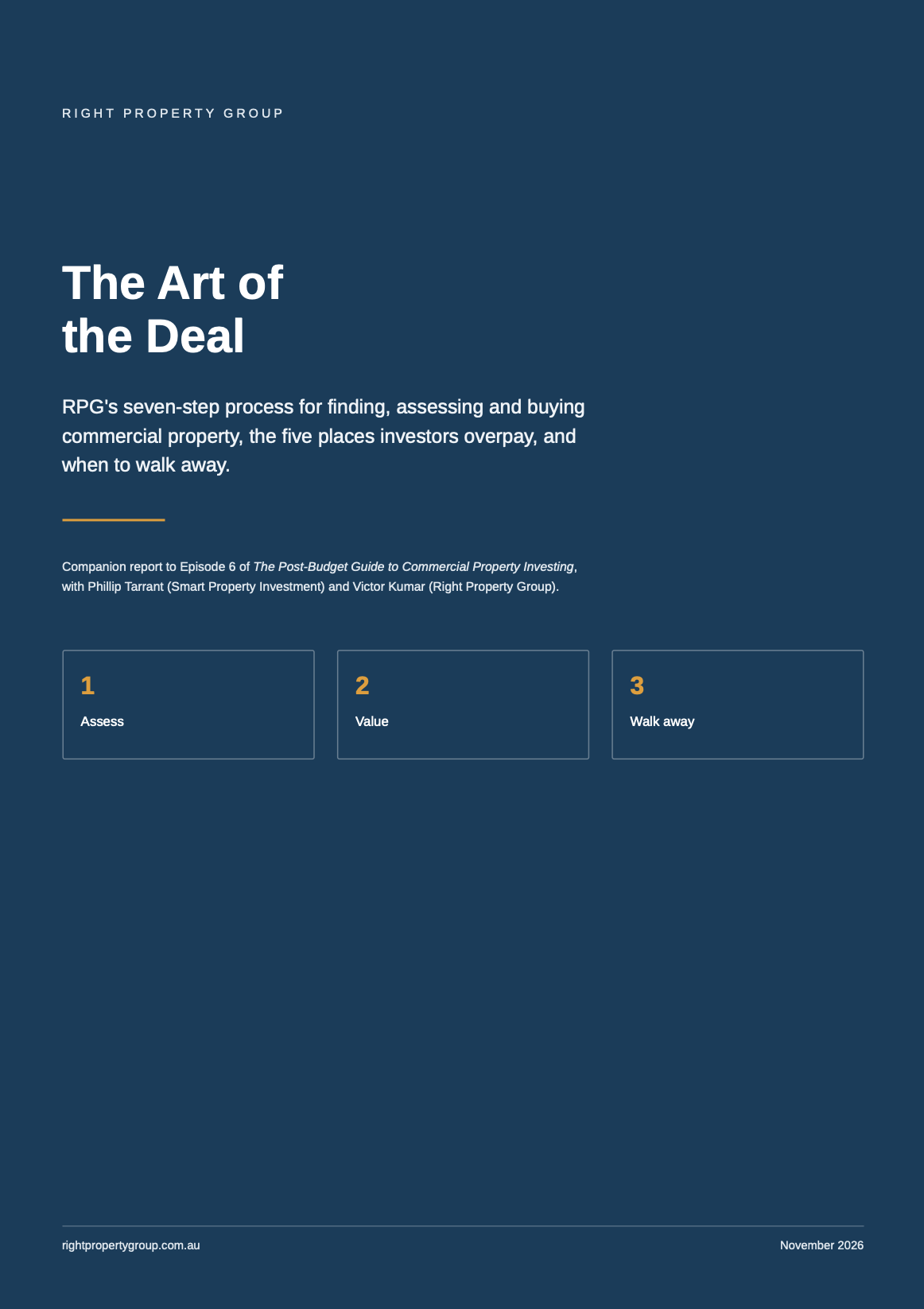
COMPANION REPORT • PART 6
The Art of the Deal
RPG’s seven-step process for finding, assessing and buying commercial property, the five places investors overpay, and when to walk away.
INSIDE THE REPORT
01
Assess
Seven steps from brief to settlement
02
Value
$2 million or $2.2 million?
03
Walk away
Check everything. Then be willing to say no.
+
Victor’s 10-point screen
Plus a due diligence checklist
PDF · 4 pages · 144 KB
Companion report to Episode 6 of The Post-Budget Guide to Commercial Property Investing, with Phil Tarrant (Smart Property Investment) and Victor Kumar (Right Property Group).