 Login
Login



Strata Insurance for Property Investors: What Owners Corporations Need to Cover Before You Buy
Buying into a strata-titled property is different to buying a standalone house, and insurance is one of the areas where that difference shows up most clearly. Instead of arranging your own building cover, you are relying on the owners corporation to hold a policy that protects the building as a whole, while you remain responsible for what happens inside your own unit.

For investors, this split creates a grey area that catches a lot of people out. Understanding exactly where the strata policy ends and your own responsibility begins is one of the most important due diligence steps before settling on any strata property.
What Strata Insurance Is Designed to Cover
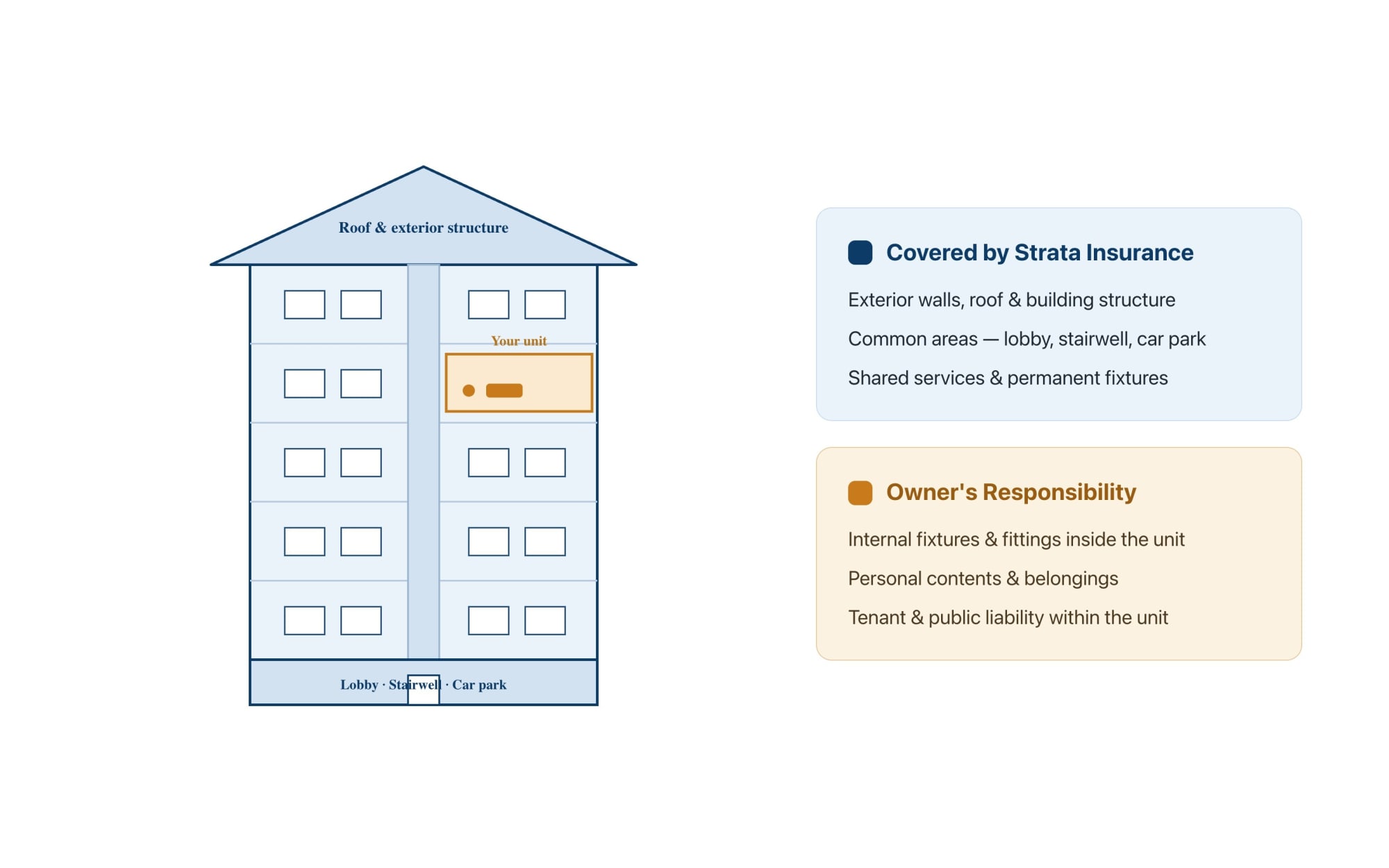
Strata insurance is a policy taken out by the owners corporation (sometimes called the body corporate) on behalf of all lot owners in a building or complex. It is usually compulsory under state legislation for the building to be insured to full replacement value. The policy is generally funded through owners corporation levies, meaning every owner contributes regardless of whether they live in the property or rent it out. Strata insurance generally covers:
-
The building structure, including walls, roofs, foundations, and common areas such as lobbies, stairwells, and car parks.
-
Shared plant and equipment, such as lifts, intercom systems, and common area lighting.
-
Public liability cover for incidents that occur in common areas.
-
Loss of rent or temporary accommodation cover for lot owners if the building becomes uninhabitable due to an insured event.
What Strata Insurance Usually Does Not Cover
This is where many investors get caught out, particularly those buying their first strata property. A strata policy is not a substitute for your own contents or landlord insurance.
| Typically Covered by Strata | Typically Left to the Owner |
|
Building structure and common property |
Fixtures the owner has installed, such as upgraded flooring or built-in cabinetry |
|
Shared plant, lifts, and common area assets |
Contents inside the unit, including appliances not fitted as standard |
|
Public liability in common areas |
Loss of rent if a tenant simply stops paying |
|
Damage to the building shell from an insured event |
Landlord liability for incidents caused by the tenant inside the unit |
The exact split between building and contents cover can vary depending on the state and the specific strata plan, particularly for older buildings or mixed commercial and residential schemes, so this is worth confirming directly rather than assuming it matches a standard residential policy.
Questions to Ask Before Buying a Strata Property
-
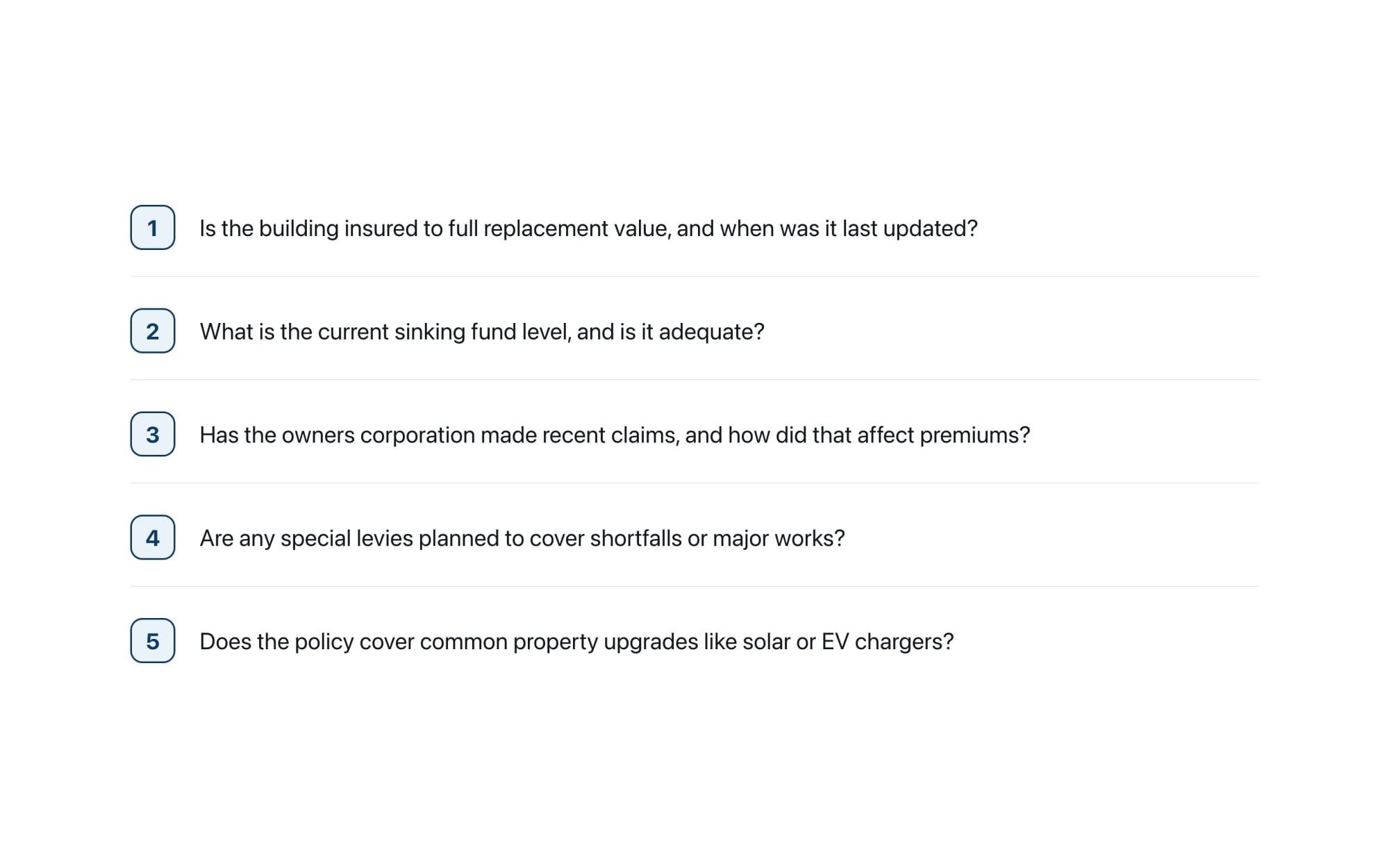
Is the building insured to full replacement value, and when was that valuation last updated?
-
What is the current level of the sinking fund, and is it adequate for upcoming maintenance or repairs?
-
Has the owners corporation made any recent claims, and what impact has that had on premiums?
-
Are there any special levies planned to cover insurance shortfalls or major works?
-
Does the strata policy include cover for common property upgrades, such as solar panels or shared EV chargers?
A strata report obtained before purchase should answer most of these questions, and it is worth reading the insurance section closely rather than skimming it. A poorly insured building, or one sitting on a thin sinking fund, can mean special levies land on your desk not long after settlement.
Commercial and Mixed-Use Strata Adds Another Layer
Investors looking at commercial or mixed-use strata properties, such as a retail lot beneath residential apartments, face a more complex insurance picture again. Retail and office tenancies can carry different liability exposures, fit-out considerations, and business interruption risks that a standard residential strata policy is not built to handle. In these buildings, it is worth confirming that the strata policy has been specifically rated for the mixed-use nature of the property, rather than assuming a generic scheme covers every lot type equally.
How Strata Insurance Premiums Are Calculated
Understanding what drives strata premiums helps investors interpret why levies rise year on year, and whether an increase reflects genuine risk or a broader market shift. These generally include:
-
Building age and construction type, since older buildings or those with known defects typically attract higher premiums.
-
Claims history for the specific building, not just the broader strata insurance market.
-
Location factors, including flood, bushfire, or cyclone exposure relevant to the site.
-
Replacement value, which needs to be reassessed periodically as building costs change, particularly during periods of high construction cost inflation.
-
Fire safety and building compliance status, since outstanding defect issues can affect both premiums and insurer appetite to cover a building at all.
Investors reviewing an owners corporation's financials should pay close attention to how premiums have trended over the past few years. A steep, unexplained increase can be a signal of an underlying issue with the building, such as a defect, a large claim, or a lapse in required maintenance, rather than simply market-wide premium inflation.
What Happens When a Sinking Fund Falls Short
The sinking fund, sometimes called the capital works fund, exists to cover major, non-routine expenses such as roof replacement, lift upgrades, or structural repairs. It sits alongside, but separate from, the building insurance policy. When a sinking fund is inadequate, owners corporations typically respond by issuing a special levy, a one-off charge to all lot owners to cover the shortfall.
-
Special levies can be substantial, sometimes running into thousands of dollars per lot depending on the works required.
-
Investors are legally responsible for special levies on a property they own, regardless of settlement timing, unless specifically negotiated otherwise in the contract of sale.
-
A consistently underfunded sinking fund is often a warning sign of poor building management more broadly.
Protecting Your Position as an Investor
Beyond understanding what the strata policy covers, investors have a few tools available to close the remaining gaps:
-
Landlord insurance to cover contents, loss of rent, and tenant-related liability that sits outside the strata policy.
-
Reviewing owners corporation meeting minutes for any flagged insurance concerns before purchase.
-
Checking whether the strata policy has an excess that would apply to your lot in the event of a shared claim.
-
Confirming your own liability exposure for anything you have altered inside the unit, such as flooring or fixtures.
Because strata cover varies significantly between buildings and states, it is worth having a specialist broker such as Insuregroup review the current policy and sinking fund position before you commit to a purchase, particularly for commercial or mixed-use strata.
Strata insurance is often treated as a background detail during a property purchase, sitting somewhere behind price, location, and rental yield on the priority list. For investors, it deserves a closer look, since a poorly insured building or an underfunded sinking fund can turn into a direct cost through special levies long after the settlement date has passed.
Want to see more stories from trusted news sources?
Make Smart Property Investment a preferred news source on Google.
Click here to add Smart Property Investment as a preferred news source.