 Login



‘Serious risk’: Property price falls leave investors scrambling for $45k at settlement
Property investors could be forced to find tens of thousands of dollars in additional cash to settle house and land purchases, as falling valuations leave banks unwilling to finance the full purchase price.
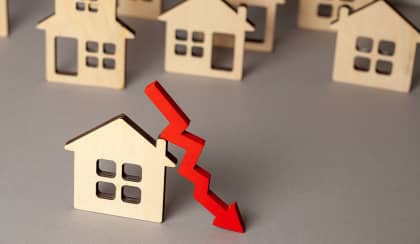
Investors who locked in house and land purchases before the property downturn could face a costly surprise at settlement, with falling valuations leaving them unable to secure sufficient finance.
Recent data showed the capital cities were nearing their worst price decline in 40 years, with established homes continuing to plummet in value across the capitals.
Additionally, Commonwealth Bank has forecast national dwelling values to decline around 14 per cent from peak to trough.
Buyers Club CEO, Ali Hallak, said due to the pace of the price declines, investors could be approved for a loan for a new build, but suddenly find they lack borrowing capacity when the property falls in value before settlement.
As a result, investors could be left trying to find tens of thousands of dollars in extra funds to allow them to settle.
“A lot of people would probably be unaware that the valuation may not stack up and that values have declined, because you only know this when the bank does a valuation,” Hallak told SPI.
“It’s a very serious risk because people can be pretty much left without a loan and then left without having to be able to turn up to settlement and could lose their deposit.”
Hallak said the risk was already emerging for off-the-plan buyers who signed on for houses six to 12 months ago, especially (self-managed super fund) SMSF investors, as they committed to prices when values were near their peak.
In particular, he said investors of properties in oversupplied, popular investment locations, such as the western and northern parts of Melbourne, were at risk.
“They were bought with already established premiums. So they already bought higher than market value because people were getting in during the SMSF rush,” he said.
“And now that prices have softened, because they’re oversupplied, there have been some very reduced resales in those areas. So those are the resales that the banks and the valuers are going to compare to.”
Hallak said a buyer who agreed to purchase a property for $1 million could face a $45,000 funding shortfall if its value fell to $950,000 by the time it was completed.
Free investor loan check
Better property decisions start with smarter lending.
A free 15-minute finance check for property investors.
What are your lending goals?
Choose a goal to request a callback.
Ready to talk?
Book a 15-minute call →Finni Pty Ltd · Australian Credit Licence 384324 · Privacy
While a buyer may have initially expected to borrow $900,000 at a 90 loan-to-value (LVR) ratio, the bank would reassess the property when completed and offer a smaller loan based on its current valuation.
“Instead of the banks lending you that, they’re only now prepared to lend you $855,000. So now you’ve got to come up with a valuation shortfall, which is the extra $45,000 required to settle that property,” he said.
The solution
To reduce the risk of a shortfall, Hallak said investors should seek valuations from multiple lenders before settlement, potentially finding a lender willing to value the property higher and offer a larger loan.
“By ordering multiple valuations, it helps you because essentially you can go to the highest valuation and then that will help you reduce the extra money that you would have to come up with,” he said.
Additionally, he said investors should look into alternative lending arrangements that let them preserve more of their savings upfront, providing a buffer to handle shortfalls at settlement.
He said that investors should consider putting down a smaller deposit and paying the lender’s mortgage insurance (LMI), allowing them to have more cash to cover a valuation gap.
“[Investors] might need to try to move to a 90 per cent loan or even a 95 per cent loan. Anything they could possibly do to reduce the amount of deposit that they require and try to get as high of a loan as possible.”
However, Hallak said one of the most effective ways to address the issue would be to have an open and honest conversation with the builder or developer to receive a potential price reduction or settlement adjustment.
“I would be going to the developer, and I would be saying, ‘Hey, valuations are falling – we may need to renegotiate the price,” he said.
“Let’s just say there’s a 50 or $60,000 shortfall. It is something where you can go back to the developer and say, ‘Hey, I need you to either throw in $30,000–40,000 to be able to settle’.”
Hallak said developers were likely to make compromises, given the likely hardship of finding new buyers for the properties once construction was completed.
“In this current market, because prices have fallen, they need those sales to settle in order to potentially carry the holding costs of the stock that isn’t selling,” he said.
Want to see more stories from trusted news sources?
Make Smart Property Investment a preferred news source on Google.
Click here to add Smart Property Investment as a preferred news source.